How RV Fireplaces Work (And Why They’re Simpler Than You Think)
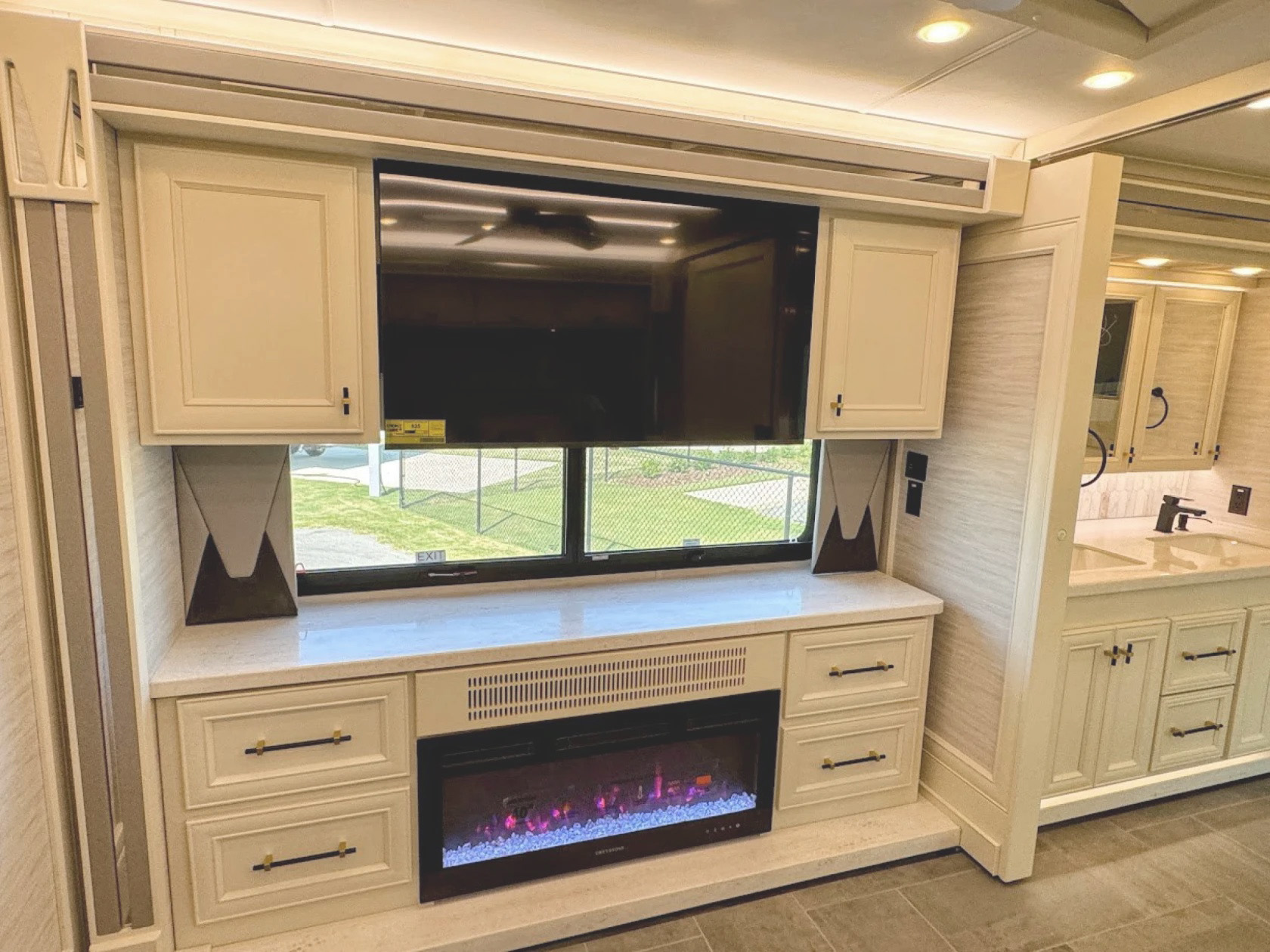
RV fireplaces spark a lot of curiosity and questions from new owners. People often assume they’re complicated gas-burning units with venting, propane lines, or safety interlocks similar to home fireplaces or RV furnaces. In reality, the vast majority of RV fireplaces installed in 2025–2026 model year travel trailers, fifth wheels, toy haulers, and motorhomes are purely electric — 110-volt AC appliances that look and feel like a cozy fireplace but operate more like a stylish space heater with LED flame effects. There’s no combustion, no exhaust, no propane, and no venting required. Understanding this simple truth removes most of the mystery and makes operation, troubleshooting, and even adding one to an older RV surprisingly straightforward.
This in-depth guide explains exactly how RV fireplaces work, what’s inside them, how they get power, realistic heating expectations, operation basics, control panel functions, common myths, safety considerations, maintenance routines, troubleshooting steps, removal and replacement, upgrade/installation possibilities, battery/inverter considerations for off-grid use, integration with other RV systems, energy efficiency tips, and an expanded FAQ section drawn from real owner questions and service bay feedback in 2026. By the end, you’ll know why RV fireplaces are one of the simplest, most reliable, and easiest-to-service features in the coach — and how they can add genuine ambiance without the complexity of gas appliances.
At Great American RV SuperStores, we see RV fireplaces on nearly every new towable and many motorized deliveries. Owners love the ambiance they add — especially in colder months — but most early confusion stems from expecting a gas appliance. Once they realize it’s just a 110-volt electric heater with visual flair, everything clicks. We’ve helped hundreds of owners operate, maintain, and even retrofit these units, so this guide draws from real-world experience to give you practical, no-nonsense advice.
Hey Happy Campers! Todd here with Great American RV SuperStores.
Today we’re taking a deep dive into how RV fireplaces work, how to operate them safely and efficiently, what to expect for heating performance, how to troubleshoot common issues, maintain the unit, remove or replace it if needed, consider adding one to an older RV, manage power draw off-grid, integrate with your RV’s electrical system, maximize energy efficiency, and answer the questions we hear most often from owners.
If you’d prefer a step-by-step visual demo, check out the full walkthrough on the Great American RV YouTube channel in our Hap’s Helpful Hacks playlist.
Let’s clear up the myths and get you enjoying that cozy glow!
Why RV Fireplaces Are Simpler Than Most People Think
Unlike home gas fireplaces or RV furnaces, the typical RV fireplace is 100% electric and operates on standard 110–120-volt AC household power. It does not burn propane, natural gas, or any fuel. There is no pilot light, no gas valve, no combustion chamber, no exhaust flue, and no carbon monoxide risk from the unit itself. The “flames” you see are created entirely by LED lights and a rotating mirror/flame wheel assembly — purely visual effects that mimic a real fire without any actual burning.
Think of an RV fireplace as a built-in electric space heater with a realistic flame display. The heating element provides supplemental warmth, the fan circulates air, and the LEDs create the fire illusion. That’s it. Because there’s no venting or gas line, installation is simple, service is straightforward, and safety concerns are minimal compared to combustion appliances. This design choice keeps weight down, eliminates venting complexity, and reduces manufacturing costs while still delivering the cozy ambiance owners want.
In newer 2025–2026 RVs, fireplaces often integrate with the coach’s 120V system seamlessly — many are hardwired to a dedicated outlet behind the unit, while some plug into a nearby receptacle for easier removal. They’re built to withstand RV vibrations, temperature swings, and the occasional bump on the road, with durable frames and tempered glass fronts.
Power Requirements and Electrical Basics
RV fireplaces run exclusively on 110–120V AC power — they do not operate on 12-volt DC from your house batteries. To use the fireplace, you must have one of the following:
- Shore power (30- or 50-amp pedestal hookup)
- Onboard generator running
- Inverter supplying 120V AC (typically 2000W+ pure sine wave inverter recommended for full heat without buzzing or damage)
Power draw is significant and varies by model:
- Flame effect + fan only: 200–400 watts (~2–4 amps at 120V)
- Low heat (750–1000W): 6–8 amps
- High heat (1500W): 12–13 amps
This makes the fireplace one of the larger 120V loads in the RV — comparable to a microwave, coffee maker, or small roof AC unit. Always monitor your total shore power or inverter capacity when using heat, especially if running other high-draw appliances simultaneously. In off-grid scenarios, the fireplace is best used sparingly unless you have a robust inverter and battery bank (e.g., 3000W inverter + 600Ah lithium).
What’s Inside the Fireplace
Behind the tempered glass front, the unit is surprisingly simple and modular:
- Electric Heating Element — Nichrome wire coil or ceramic PTC heater (750W/1500W selectable) generates real heat.
- Blower Fan — Quiet axial or squirrel-cage fan circulates warm air out front vents.
- LED Lighting Assembly — Multi-color RGB LEDs create flame color, intensity, and flicker effects.
- Flame Effect Mechanism — Rotating drum or ribbon with printed flame pattern + reflective mirror and backlighting simulates realistic fire movement.
- Control Board — Manages heat settings, fan speed, LED patterns, timer, thermostat (if equipped), and remote functions.
- Thermostat Sensor — Monitors internal temp to prevent overheating and cycle heat on/off.
- Power Cord — Standard 3-prong 120V plug connects to RV outlet (often hidden behind unit; some hardwired).
- Frame and Glass — Metal housing with safety glass front; some models have removable ember beds for cleaning.
No gas lines, no burners, no exhaust ports — just a self-contained electric appliance that’s easy to service or replace.
Typical Control Panel and Remote Functions
Most RV fireplaces (Dimplex, Touchstone, Twin-Star, Electraflame, or LCI-branded) use similar controls, either on the unit or via infrared remote:
- Power On/Off — Main button to start/stop unit.
- Heat Low/High/Off — Selects 750W or 1500W heating.
- Flame Brightness/Color — Cycles through flame intensity and color options (some models have fixed orange; others allow blue/green/red effects).
- Timer (1–8 hours) — Auto shut-off for safety and energy savings.
- Fan Only — Runs fan and flame effect without heat.
- Thermostat Mode (on some) — Set desired room temperature; unit cycles heat to maintain it.
- Remote Control Pairing — Hold buttons to sync replacement remote.
- Child Lock — Locks controls to prevent accidental changes.
Operation is intuitive: unlock if locked, select heat level, adjust flame effect, set timer if desired. Many models remember last settings on power-up.
Realistic Heating Expectations and Performance
RV fireplaces are supplemental heat, not primary sources. They provide:
- 5,000–5,100 BTU/hour on high (1500W) — equivalent to a medium space heater.
- Effective in small-to-medium spaces (living area, bedroom, 100–250 sq ft).
- Quick warmth near the unit — heat radiates forward and upward.
- Reduced furnace runtime — saves propane and battery draw from blower.
- Ambience — cozy glow without actual fire hazards.
Limitations:
- Heat rises — won’t warm floors, underbelly areas, or tanks/plumbing (furnace still required).
- Single room focus — not whole-coach heating in large rigs.
- 1500W max — can’t compete with 20,000–40,000 BTU furnace in sub-freezing conditions.
- Power draw — high usage shortens off-grid battery life unless solar/inverter robust.
Best uses: taking the chill off in shoulder seasons, zone heating living area while furnace protects plumbing, or creating ambiance during cool evenings.
Operation Step-by-Step
- Ensure 120V power — shore, generator, or inverter.
- Plug in fireplace (if not hardwired) or confirm circuit breaker on.
- Turn on unit (power button on panel or remote).
- Select heat level (low/high).
- Adjust flame brightness/color/effect.
- Set timer if desired (safety/energy saving).
- Enjoy — fan circulates heat forward; LEDs create flame.
Turn off when leaving RV unattended or if using high heat for extended periods.
Common Myths and Misconceptions
Myth: “It runs on propane or gas.” No — 100% electric. No gas lines or combustion.
Myth: “It vents outside or produces CO.” No venting required — no combustion, no CO from unit (still use RV CO detectors).
Myth: “It heats the whole RV like a furnace.” Supplemental only — furnace handles tanks, plumbing, large spaces.
Myth: “It’s hard to install or replace.” Simple — plug-in or hardwired; many owners retrofit older RVs.
Myth: “It’s unsafe for kids/pets.” Safer than gas — cool-touch glass on many models; use child lock.
Safety Considerations
- Never block vents — airflow prevents overheating.
- Keep flammable items (curtains, blankets, papers) 3 ft away.
- Use on dedicated 20A circuit if possible — avoid overloading.
- Turn off when leaving RV unattended for long periods.
- Child lock on digital models prevents accidental heat activation.
- No CO risk from unit — still maintain RV CO/propane detectors.
- Don’t cover or drape items over fireplace — fire hazard.
Maintenance and Care Tips
- Clean glass front — microfiber cloth + glass cleaner (unit off, cool).
- Vacuum intake/exhaust vents — dust buildup reduces airflow.
- Inspect power cord/plug — no fraying, overheating, or damage.
- Check outlet — secure, no scorch marks.
- Annual wipe-down — remove front panel (if removable) to dust internals.
- Monitor for unusual noise — fan bearings can wear; replace unit if loud.
Removal and Servicing
Most units are easy to service:
- Remove screws behind glass or trim panel.
- Unplug power cord (or disconnect hardwire).
- Slide unit out as one piece.
Replacement: measure opening (typically 30–40″ wide), ensure 120V outlet, secure per manufacturer. DIY-friendly for most owners.
Adding a Fireplace to an Older RV
Popular upgrade for pre-2020 rigs:
- Find blank wall, cabinet, or fireplace cutout with 120V nearby.
- Measure opening (standard sizes 28–40″ wide).
- Install dedicated outlet if needed (20A circuit recommended).
- Cut opening to fit, secure unit, ensure clearance/airflow per specs.
- Cost: $300–$800 unit + $200–$500 install (DIY possible).
Benefits: adds ambiance, supplemental heat, resale value.
Battery/Inverter Considerations for Off-Grid Use
- Requires inverter — 2000W+ pure sine wave recommended (handles 1500W heat + surge).
- Draw ~1500W on high — monitor inverter load and battery SOC.
- Use only for short periods off-grid unless large solar/battery bank (e.g., 3000W inverter + 800Ah lithium).
- Flame-only mode (200–400W) extends runtime significantly.
- Pair with solar — 600W+ panels recharge during day.
Expanded Frequently Asked Questions
Does it produce real heat? Yes — 1500W element; 5,000 BTU supplemental warmth.
Can it run on batteries? No — needs 120V AC from inverter or shore.
Why no flame when heat off? Some models allow flame-only; check remote or manual.
How much power on flame only? 200–400W — fan + LEDs.
Can I replace with gas fireplace? Possible but requires venting/gas line — major modification.
Why does it trip breaker? High draw + other loads — use dedicated 20A circuit.
Is it safe to leave on overnight? Yes with timer and good ventilation — monitor first uses.
Best temp setting? Thermostat models auto-cycle; manual = low for ambiance.
How to clean LED/flame wheel? Remove front, gentle vacuum/dust — power off.
Can kids operate? Use child lock; supervise heat function.
Why does fan run after heat off? Cool-down cycle — normal; prevents hot spots.
Can I hardwire instead of plug-in? Yes — many are hardwired at factory; electrician can convert.
Is it ventless? Yes — no venting needed.
How loud is it? Quiet fan hum — comparable to small space heater.
The Bottom Line
RV fireplaces are simple electric space heaters with beautiful flame effects — no gas, no venting, easy service. Ensure 120V power, use safely, maintain vents, and enjoy the ambiance. Supplemental heat at its easiest.
By understanding:
- It’s 110V electric only.
- Realistic heating limits.
- Simple controls and maintenance.
- Easy upgrade potential.
- Off-grid power considerations.
You’ll use it confidently and appreciate the cozy touch it adds to your RV.
Watch the Full Video Walkthrough See everything demonstrated step-by-step in our How RV Fireplaces Work video from the service team. Find it on the Great American RV SuperStores YouTube channel in the Hap’s Helpful Hacks playlist.
At Great American RV SuperStores, we don’t just sell RVs we help you understand how to use them. We’re making memories one weekend at a time. 🚐
*This content is not a legal standard or regulation, and does not create any new legal obligation. It is advisory in nature, informational in content, and is intended to assist and educate consumers in the use and enjoyment of their recreational vehicles. Great American RV SuperStores does not hereby make any warranty, express or implied, and does not assume any liability with respect to the use of, or damages resulting from the use of any information, method or process included in this content.
Recent Comments