RV Towing Safety Tips Every Camper Should Know
Towing an RV isn’t just about hooking up and hitting the road. It’s about making sure your connections, lights, brakes, and weight setup are all correct before the first mile. A few quick checks can be the difference between a smooth trip and a dangerous one.
Here’s how to make sure your trailer is ready to roll safely every time.
Hey Happy Campers!
Todd here with Great American RV SuperStores.
Today we’re going over towing safety tips — everything from verifying your lights and brake controller, to balancing your load, preventing sway, and testing your brakes before hitting the road.
We’ll cover:
- Checking trailer lights and brake power
- Testing your 7-way plug and fuses
- Understanding your breakaway system
- Proper weight distribution and sway control
- Using and testing your brake controller
- Knowing your true RV height before travel
Let’s get started.
Step 1: Check Your 7-Way Plug and Fuses
Start by making sure your 7-way plug is seated tightly and fully connected. Loose connections are one of the most common reasons trailer lights or brakes stop working.
If your lights or brake controller aren’t sending power to the trailer, check your truck’s fuse panel under the hood. Your owner’s manual will list the exact fuses for:
- Trailer left and right turn signals
- Trailer brake lights
- Trailer battery charge circuit
Replace any blown fuses with the correct amperage.
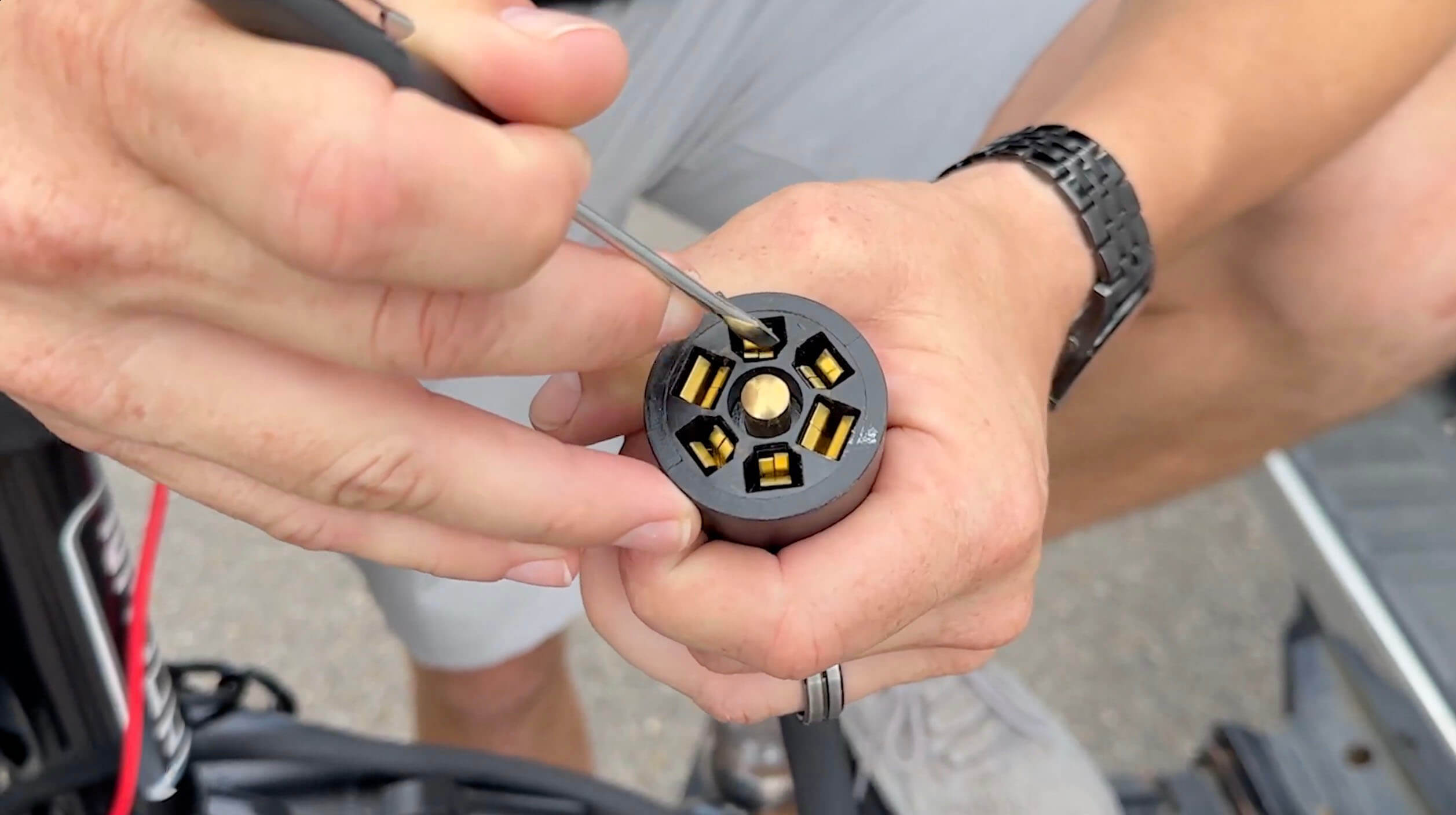
If everything checks out, inspect the trailer’s plug. Take a flathead screwdriver and gently squeeze the metal prongs together. Over time, they can spread apart and lose good contact with the truck’s plug.
Step 2: Verify Your Breakaway Cable
Your breakaway cable is a small but critical safety feature. It’s connected to a small switch box on the trailer tongue that applies your trailer brakes if the trailer ever disconnects from the tow vehicle.
Make sure:
- The cable clips directly to your receiver hitch, not to your safety chains.
- The 12-volt trailer battery is fully charged. The breakaway system won’t work without it.
- The pin is fully inserted into the switch box while towing. If it’s even slightly pulled out, it can activate the trailer brakes during travel.
If the trailer ever comes off the hitch, that pin pulls out, the circuit closes, and the brakes engage, bringing the trailer to a stop.
Step 3: Balance and Distribute Your Weight
Improper loading is one of the main causes of trailer sway and instability.
Follow these key points:
- Load evenly from side to side.
- Keep heavy items low and centered over the axles.
- Avoid putting too much weight in the rear. That lifts the weight off the hitch and can cause sway.
When you hook up your weight distribution hitch, check that the truck and trailer sit level. If the truck’s rear is sagging and the front is light, you’ll lose steering and braking control. Adjust your hitch bars or tension as needed to even things out.
Step 4: Understand and Test Your Brake Controller
Your tow vehicle should have a brake controller, either factory-installed or aftermarket. It regulates how much power is sent to the trailer brakes.
Take a few minutes to review the brake controller’s owner’s manual. Most use a 1–10 scale for brake voltage:
- 1 is minimal braking assistance.
- 10 is the maximum brake output.
Set it so your trailer brakes smoothly without locking up.
How to Test It
Before you drive:
- With your trailer connected, put your truck in drive.
- Hold down the manual slider on the brake controller. This sends full power to the trailer brakes.
- You should feel the trailer hold you still.
If it doesn’t, your trailer brakes may need adjustment or you could have a power issue at the plug or fuse panel.
Step 5: Handling Trailer Sway
Even a properly loaded trailer can sway from wind, passing trucks, or uneven road surfaces.
If sway starts:
- Don’t slam your truck brakes.
- Ease off the gas and hold the wheel steady.
- Manually apply the trailer brakes by sliding the brake controller lever slowly. That engages the trailer brakes only, pulling it back in line.
Avoid over-steering. Controlled trailer braking will settle the sway faster and safer than anything else.
Step 6: Know Your Real RV Height
The manufacturer’s listed height doesn’t always reflect your true travel height once hitched to the truck.
Before traveling, climb up and measure from the top of your air conditioner (or the tallest point on the roof) down to the ground.
Knowing your actual height helps prevent collisions with bridges, gas station awnings, or drive-thru canopies.
Recheck it if you’ve added anything to your roof, like solar panels, racks, or satellite domes.
Building a Safe Towing Routine
Safe towing isn’t about remembering every detail once — it’s about building habits that become automatic. The most experienced RV owners don’t rely on memory or luck. They rely on a repeatable routine they follow every single trip.
Before pulling out, take the same walk-around in the same order every time. Check the hitch, safety chains, breakaway cable, and 7-way plug. Confirm lights and brake operation. Verify tire pressure and do a quick visual scan for anything out of place. Consistency is what prevents small issues from being missed.
It’s also smart to recheck your setup after the first few miles. Pull into a safe spot, walk around again, and make sure nothing has shifted. Hitch components can settle, straps can loosen, and loads can move once you’re rolling.
Finally, remember that conditions change. Wind, rain, traffic, and road quality all affect towing. Slow down when conditions aren’t ideal, increase following distance, and give yourself extra room to brake. Arriving a few minutes later is always better than not arriving at all.
Towing safely isn’t complicated — it’s intentional. When you treat every trip with the same level of attention, safe towing becomes second nature.
Final Thoughts
Before every trip, take a few minutes to walk around your setup and confirm:
- 7-way plug is tight and clean
- All lights and signals are working
- Breakaway cable is attached correctly
- Hitch and sway bars are secure
- Tires are properly inflated and free of cracks
- Brake controller is tested and responsive
These quick checks help you tow safely and confidently, every time.
Common RV Towing Mistakes (And Why They’re Dangerous)
Most towing incidents don’t happen because someone ignored safety entirely. They happen because a driver assumed something was “probably fine.” These are the most common mistakes RV owners make — and why they matter.
Skipping a Brake Test Before Driving
Many owners assume that if the truck brakes feel normal, the trailer brakes must be working too. That’s a bad assumption.
Trailer brakes are a separate system. If they’re not functioning, your stopping distance increases dramatically, especially downhill or during emergency braking. A quick manual slider test before driving can reveal wiring issues, blown fuses, or brake problems before you’re moving at highway speed.
Attaching the Breakaway Cable Incorrectly
One of the most common mistakes is clipping the breakaway cable to the safety chains instead of the hitch receiver.
If the trailer separates and the chains fail, the breakaway cable may never pull the pin. That means the trailer brakes never activate. The cable should always be clipped directly to a solid point on the tow vehicle’s hitch — never to the chains.
Driving With Improper Weight Distribution
A trailer that isn’t balanced correctly may tow fine at low speeds, then become unstable once wind, hills, or passing trucks come into play.
Too much rear weight lifts pressure off the hitch, reducing steering control and braking effectiveness. Proper weight distribution keeps both axles planted and dramatically reduces sway.
Reacting Incorrectly to Trailer Sway
When sway starts, instinct tells most drivers to hit the brakes. That often makes things worse.
Braking the tow vehicle transfers weight forward and can intensify sway. The correct response is to ease off the throttle and apply the trailer brakes manually. This pulls the trailer straight without upsetting the truck.
Assuming the Listed RV Height Is Accurate
Manufacturer height specs are often measured under ideal conditions. Once hitched, your RV may sit higher or lower depending on suspension, tires, or hitch setup.
Many roof strikes happen because drivers relied on brochure numbers instead of measuring the actual travel height themselves.
Ignoring Tire Pressure and Condition
Tires are the foundation of towing safety. Underinflated or aging tires are far more likely to overheat, lose stability, or fail completely.
Always check tire pressure cold, inspect for cracks, and verify load ratings match the trailer’s weight.
Not Doing a Final Walk-Around
A simple walk-around catches issues like:
- Unlatched hitch couplers
- Loose sway bars
- Unplugged 7-way cords
- Dragging safety chains
This takes two minutes and can prevent hours of roadside problems.
Why These Details Matter
Towing an RV isn’t forgiving. Small oversights can quickly become big problems once speed, weight, and momentum are involved. The goal isn’t perfection — it’s consistency.
Developing a repeatable pre-trip routine dramatically reduces risk and makes every trip calmer and more predictable.
Want a Deeper Dive?
You can find detailed videos on sway control, brake controller setup, and weight distribution on our Great American RV YouTube channel in the Hap’s Helpful Hacks playlist.
Like, share, and follow for more RV how-to guides.
Here at Great American RV SuperStores, we bring the how-to to you.
*This content is not a legal standard or regulation, and does not create any new legal obligation. It is advisory in nature, informational in content, and is intended to assist and educate consumers in the use and enjoyment of their recreational vehicles. Great American RV SuperStores does not hereby make any warranty, express or implied, and does not assume any liability with respect to the use of, or damages resulting from the use of any information, method or process included in this content.
Recent Comments