Understanding 110-Volt Electrical Systems in Towable RVs
One of the most common areas of confusion for RV owners — especially those new to towable units like travel trailers, fifth wheels, toy haulers, and destination trailers — is the 110-volt (120V AC) electrical system. Where does the power come from? How is it distributed inside the RV? What happens when an outlet, microwave, air conditioner, or fireplace stops working? Once you understand the basics, troubleshooting becomes straightforward, and you can often resolve issues yourself without a service call. This detailed guide explains the entire 110-volt system in towable RVs: power sources, breaker panels, GFCI outlets, plugs and cords, generator transfer switches, inverters, common failure points, step-by-step troubleshooting, preventive maintenance, safety best practices, off-grid considerations, and an expanded FAQ section based on real owner questions and service bay feedback in 2026.
At Great American RV SuperStores, we field 110-volt questions every day during deliveries, PDI checks, and service visits. Most problems trace back to tripped breakers, tripped GFCIs, corroded plugs, low-quality shore power, or overloaded circuits — all preventable with basic knowledge. Whether you have a 30-amp or 50-amp service, this guide will help you understand your RV’s AC electrical system so you can camp confidently.
Hey Happy Campers! Todd here with Great American RV SuperStores.
Today we’re taking a deep dive into the 110-volt electrical system in towable RVs — how power enters the coach, where it’s distributed, what the breaker panel really does, why GFCI outlets trip so often, how 30-amp vs 50-amp service differs, generator transfer switches, inverters, troubleshooting step-by-step, preventive maintenance, safety tips, off-grid inverter use, and answers to the questions we hear most frequently from owners in 2026.
If you’d prefer a step-by-step visual demo, check out the full walkthrough on the Great American RV YouTube channel in our Hap’s Helpful Hacks playlist.
Let’s get your 110 volts flowing smoothly!
The Big Picture: Where 110-Volt Power Comes From
Towable RVs have two completely separate electrical systems:
- 12-volt DC — Powered by house batteries; runs lights, pumps, furnace blowers, control boards, slides, etc.
- 110–120-volt AC — Household-style power; runs high-draw appliances (AC units, microwaves, fireplaces, TVs, outlets).
The 110-volt system only works when the RV is connected to one of these sources:
- Shore Power — Pedestal hookup (30-amp or 50-amp).
- Onboard Generator — Automatic or manual start; powers entire coach.
- Inverter — Converts 12V DC battery power to 120V AC (limited capacity; usually powers select outlets/appliances).
All three sources feed into the same breaker panel inside the RV, which then distributes power to branch circuits.
The Main Breaker Panel: Where It All Starts
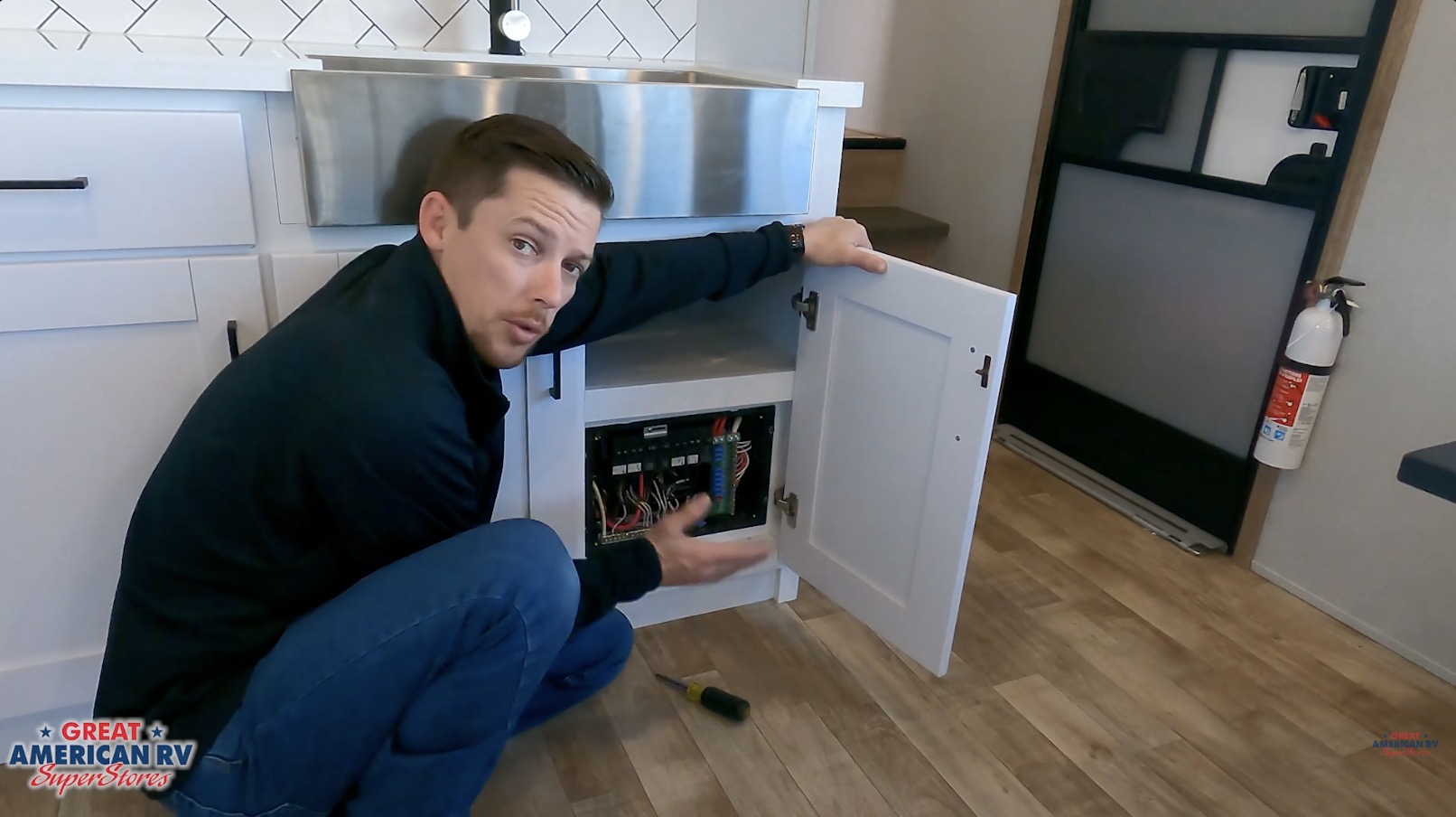
Inside your RV (usually in a cabinet, wardrobe, or under dinette), you’ll find a breaker panel that looks similar to a home electrical panel. It contains both:
- 110-volt AC breakers (single-pole or double-pole)
- 12-volt DC fuses
The 110V side is fed by shore power, generator, or inverter. The 12V side is fed by batteries and the converter (which converts 110V to 12V when shore power is available).
Typical 110V loads on breakers:
- Air conditioners (often 20–30A double-pole)
- Microwave (15–20A)
- Fireplace/electric heaters (15–20A)
- Wall outlets (15A)
- Converter (30A main input)
- TV/entertainment (15A)
Safety note: Before removing the panel cover or working near breakers, shut off all power sources — unplug shore cord, shut down generator, turn off inverter if equipped.
50 Amp vs 30 Amp RV Electrical Service
The way power enters your RV depends on the service type.
50 Amp Service
- Plug: 4-prong (NEMA 14-50) — two hot legs (L1 & L2), neutral, ground.
- Receives two separate 110-volt legs (120V each) + neutral.
- Total capacity: 12,000 watts (50A × 240V).
- Allows running multiple high-draw items simultaneously (two ACs, microwave + fireplace).
- Breakers split across L1 and L2 legs for balanced load.
30 Amp Service
- Plug: 3-prong (NEMA TT-30) — one hot leg, neutral, ground.
- Receives one 110-volt leg (120V).
- Total capacity: 3,600 watts (30A × 120V).
- Requires careful load management — can’t run two ACs or AC + microwave simultaneously.
Adapters exist (50-to-30 or 30-to-50), but use with caution — they limit power to the lower service rating.
Breaker Basics and Troubleshooting
If an appliance or outlet stops working, check the breaker panel first.
Tripped breaker signs:
- Fully down position
- Halfway/tripped position (feels loose)
To reset:
- Flip breaker fully OFF.
- Flip firmly back ON.
- Test appliance/outlet.
If breaker trips immediately:
- Overload — too many devices on circuit.
- Short circuit — damaged cord, faulty appliance, water intrusion.
- Ground fault — GFCI issue downstream.
Do not keep resetting a tripping breaker — diagnose the cause.
GFCI Outlets: A Common Trouble Spot
All RVs have GFCI (Ground Fault Circuit Interrupter) outlets in wet areas:
- Kitchen
- Bathroom
- Exterior outlets
- Wet bay or garage areas
A GFCI protects against shocks by monitoring current balance. If imbalance detected (e.g., current leaking to ground), it trips and cuts power to itself and all downstream outlets on the same circuit.
If outlets stop working:
- Locate nearest GFCI outlet (often kitchen counter or bathroom).
- Press TEST (should trip).
- Press RESET — power should return.
- If won’t reset: Unplug everything on circuit, dry area, retry.
- Still won’t reset: No incoming power — check breaker, shore cord, generator.
Common GFCI triggers:
- Hair dryers, curling irons
- Water splash
- Faulty appliance
RV Power Plugs: What to Inspect
Your RV’s shore power cord is a critical link:
- 50-amp: 4-prong (two hots, neutral, ground)
- 30-amp: 3-prong (one hot, neutral, ground)
Inspect regularly for:
- Corrosion on prongs
- Burn marks or melting
- Cracked insulation
- Loose plug fit at pedestal or RV inlet
Any damage = replace cord immediately — overheating risks fire.
Generator Transfer Switch Explained
If your RV has an onboard generator, it includes an automatic transfer switch (ATS):
- Prioritizes shore power when plugged in.
- Switches to generator when shore unplugged and genny running.
- Prevents back-feeding (safety feature).
If generator runs but no power:
- Check generator breakers.
- Verify ATS switching (listen for click).
- Test voltage at panel.
ATS failures are rare but usually electrical — service required.
Inverters: Turning 12V into 110V
Many towables include or owners add inverters to run 120V appliances off batteries:
- Modified sine wave — cheaper, works for basic loads.
- Pure sine wave — cleaner power for sensitive electronics (TVs, chargers).
Inverters power:
- Select outlets (often labeled)
- Residential refrigerators
- TVs/entertainment
Limitations:
- Draw heavily from batteries — 1500W load ≈ 150A from batteries.
- Not for whole-coach use unless large inverter + big battery bank.
The Big Picture: Power Flow Summary
- Shore power → RV inlet → ATS → Main breaker panel → Branch breakers → Outlets/appliances.
- Generator → ATS → Same path.
- Inverter → Batteries → Select outlets/appliances.
All 110V loads pass through the breaker panel.
Step-by-Step Troubleshooting Flowchart
- No power anywhere — Check shore cord, pedestal breaker, generator fuel/start, ATS.
- Partial power — Check main breaker panel; reset tripped breakers.
- Outlet/appliance dead — Check GFCI (reset), branch breaker, test with known good device.
- Breaker trips repeatedly — Unplug everything on circuit; reset; plug in one at a time to isolate fault.
- GFCI won’t reset — Unplug all, dry area, retry; no power = upstream issue.
Preventive Maintenance Tips
- Inspect shore cord monthly — prongs, insulation.
- Test GFCI outlets monthly — press TEST/RESET.
- Keep breaker panel clean/dry — no water intrusion.
- Check pedestal connections — no corrosion.
- Use surge protector at pedestal — protects against voltage spikes.
- Monitor total load — avoid overloading 30-amp service.
Safety Best Practices
- Turn off all power before opening panel.
- Never bypass breakers or GFCIs.
- Use 30/50-amp surge protectors.
- Keep flammable items away from outlets.
- Test CO/smoke detectors regularly.
- Don’t overload circuits — one high-draw item per 15/20A breaker.
Expanded Frequently Asked Questions
Why does my microwave trip the breaker? High draw (10–15A) + other loads — use dedicated circuit or reduce simultaneous use.
GFCI trips every time I plug in hair dryer? Hair dryers cause nuisance trips — use non-GFCI outlet or dedicated circuit.
No power when plugged in? Check pedestal breaker, cord connection, main breaker, ATS.
50-amp RV on 30-amp adapter — what happens? Limited to 30 amps total — manage loads carefully.
Why does breaker feel loose? Tripped position — flip off then on firmly.
Can I run AC + microwave on 30-amp? No — overloads; run one at a time.
Inverter runs TV but not microwave? Microwave draw exceeds inverter capacity — check wattage.
Shore power works but generator doesn’t? Check genny breakers, ATS switch, fuel.
How to test outlet voltage? Multimeter: 115–125V normal; 0V = no power.
Best surge protector? Progressive Industries or Surge Guard — 30/50-amp models.
The Bottom Line
Your towable RV’s 110-volt system is straightforward once you understand the flow: shore/generator/inverter → ATS → breaker panel → branch circuits → appliances. Check breakers and GFCIs first for most issues, maintain cords and connections, and manage loads to avoid trips. With basic knowledge, you can troubleshoot 90% of problems yourself.
By mastering these basics:
- Know your 30/50-amp limitations.
- Reset breakers and GFCIs correctly.
- Inspect plugs and cords regularly.
- Use surge protection.
You’ll have reliable 110V power and fewer interruptions on every trip.
Watch the Full Video Walkthrough See everything demonstrated step-by-step in our Understanding 110-Volt Electrical Systems in Towable RVs video from the service team. Find it on the Great American RV SuperStores YouTube channel in the Hap’s Helpful Hacks playlist.
At Great American RV SuperStores, we don’t just sell RVs we help you understand how to use them. We’re making memories one weekend at a time. 🚐
*This content is not a legal standard or regulation, and does not create any new legal obligation. It is advisory in nature, informational in content, and is intended to assist and educate consumers in the use and enjoyment of their recreational vehicles. Great American RV SuperStores does not hereby make any warranty, express or implied, and does not assume any liability with respect to the use of, or damages resulting from the use of any information, method or process included in this content.
Recent Comments